

With EDIT: Stories, SILCOHAUS visits makers whose work quietly shapes the way we live with objects. Kenny Son runs Studio KYSS out of a shared workshop in Marrickville. He is a metalsmith, a teacher, and someone who believes an object earns its place by doing its job quietly, for a long time. This is a conversation about what that looks like.
A teapot comes back
When we arrive at Kenny's workshop, a copper teapot is sitting on the bench with a dent across its body. It had been made here, gone out into the world, and come back for repair. Kenny has already worked the metal smooth. Soon it will go to the platers for a fresh coat of tin, the handle will go back on, and it will leave again — this time to the person who has been waiting to take it home.

Studio KYSS, Marrickville © SILCOHAUS
This is what Kenny makes. Objects that have a life. They go out into the world, get held, get used, get marked, and come back when they need to. Not objects that sit behind glass. The things he puts into people's hands are meant to stay there.

The teapot, back for repair © SILCOHAUS
He has a term for the opposite. A dead object. Something beautiful enough to buy but not comfortable enough to use. You bring it home, set it on the table, show it to a friend. Then it moves to the shelf. Then the back of the shelf. Then you stop noticing it at all. It takes up space and nothing else. The life it was supposed to have never started.
"When something is supposed to function but doesn't quite work, it gets pushed further and further away. Eventually it just takes up space. My idea of work with life is something people interact with."

Kenny in conversation © SILCOHAUS
The quiet life of an object
Kenny works with shapes everyone already knows. Circles, rectangles, ovals. He starts from flat sheets of metal and turns them into three-dimensional forms that hold, pour, contain, or assist. The scale is always the desk, the table, the kitchen. Things you pick up with your hands and set down without thinking about it.

Brass and copper offcuts © SILCOHAUS

On the workbench © SILCOHAUS
"I like work that just sits there. You don't notice it. But when you actually use it, once, twice, three times — one day you go, hang on, that's just perfect for me."

Objects by Studio KYSS © SILCOHAUS
That is why he never makes too much of anything. He works in small batches, avoids trends, and stops production when there is no demand. The goal is that the thing you take home might be the last one of its kind you ever need.
What Korea gave him
Kenny studied silversmithing and object design in Sydney. But the thing that changed how he works was a six-month mentorship in Korea with master craftsman Cho Sung Jun, born in 1945. Six days a week, nine to six. Traditional tools, traditional methods, every movement repeated until the hand understood before the mind did.
"I don't make traditional work. There are other people for that. My interest is the modern, the contemporary. Using what I've learned and making things that people could use in their homes of today."
One of the techniques he brought back is ipsa (입사) — a traditional Korean inlay method where fine silver wire is set into a steel surface. During our visit, Kenny showed the process from the beginning.

Scoring the steel for ipsa © SILCOHAUS

Heating silver wire for inlay © SILCOHAUS
When the hammer comes down, the teeth grip the wire and hold it. The silver becomes part of the steel. It does not sit on top. It lives inside. It is one of the rarest techniques still practised anywhere, and the clearest expression of what Korea gave him — a way of working where nothing is rushed and every mark is deliberate.

Silver inlaid into steel © SILCOHAUS
There is a Korean aesthetic in his work that he does not put there on purpose. It comes out in the proportions, in the surface, in the way something sits. He made a tea leaf tray for the upcoming exhibition and only later realised it resembled the entrance of the Olympic Park in Seoul. He had not been thinking about it. It was just in his hands.

The tea leaf tray © SILCOHAUS

Olympic Park, Peace Gate, Seoul, South Korea. © Seoul Metropolitan Government / Seoul Research Data Service (CC BY 4.0)
Material decides the colour
Kenny does not begin with colour. He begins with what the object needs to do, and the material follows. If it needs hardness, brass. If it touches food, tin plating. If it belongs in a modern setting, nickel silver or aluminium. The colour is always the consequence of the material, never a choice made independently of it.

Copper, brass, silver — colour follows material © SILCOHAUS
"The colour just follows the form and function and what the actual work needs to be."
Copper carries its own warmth. Brass has its own weight. Tin reads as a quiet, muted silver. These are not applied finishes. They are the materials themselves, left as they are. And over time, some of them change. Patina builds. The surface records use rather than disguising it.
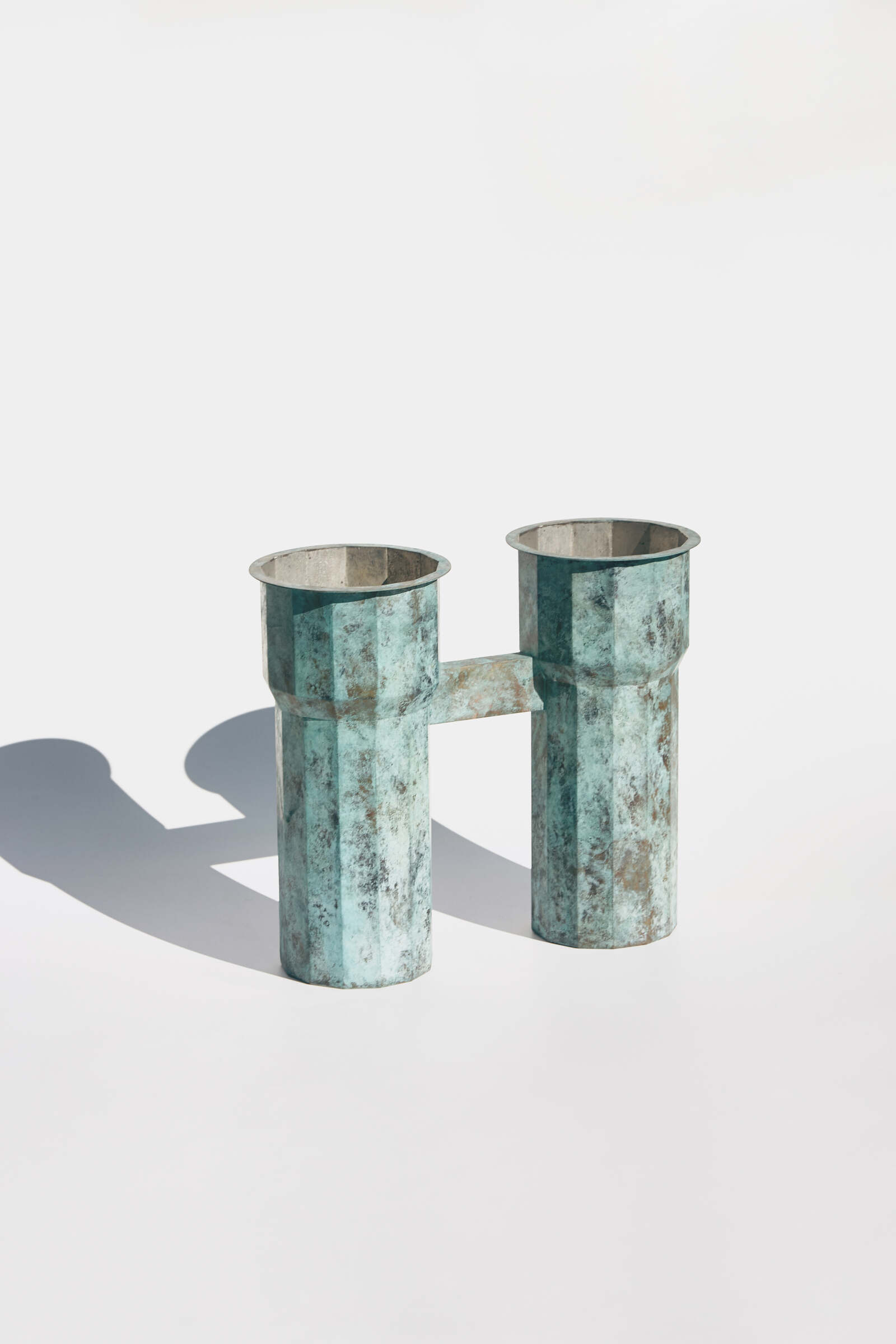
Patinated Twin Brass Water Tower © Studio KYSS
The one exception was a series of vases called Water Towers, inspired by the Becher photographs of industrial water towers across post-war Europe. Those structures survived decades. They aged visibly. Kenny wanted his vases to carry that same sense of endurance, so he deliberately applied patina to the copper. It is the only time in his practice he has used colour with intention, and even then, the intention was not decoration. It was time.
A space for more than exhibition
Kenny's workshop sits inside One Less Decision, a shared space in Marrickville. He has organised four exhibitions here, each built around the same principle: people should not just look at the work. They should interact with it.

Past exhibition: 'Picnic' at One Less Decision © One Less Decision
Kenny does not want gallery exhibitions. He finds them sterile. People walk in, look, nod, leave. Nothing is touched. What he wants is the opposite — someone holding the teapot, pouring from it, feeling how the handle sits. Not something to admire from a distance. Something that belongs in their kitchen.
"I want twenty-year-olds, six-year-olds, neighbours down the road, people who have nothing to do with metalcraft."

Kenny in conversation © SILCOHAUS
The next one, Brewed, opens 26 July. Ten designers and makers showing hand-crafted objects for tea and coffee — not the drinks, but the tools and vessels that shape how they are prepared and experienced.

Upcoming exhibition: 'Brewed' © One Less Decision
On the bench, pieces for Brewed are taking shape. One of them is a metal tea tray designed for the Chinese tea ritual. During preparation, hot water is poured generously over the cups to clean and warm them. The excess passes through the tray, travels down a slight internal slope, and leaves through an opening in the side. Beneath it, a separate vessel catches the water like a small pond.

Work in progress for Brewed © SILCOHAUS

Gravity does the work © SILCOHAUS
The engineering is simple. Gravity does the work. Kenny just gives it somewhere to go.
"I like objects that can create a conversation. That setting, that tea time — it becomes a lot more interesting because of the object on the table."
Light enough to see
Kenny works to millimetres. At that precision, light is not atmosphere. It is a tool.

Kenny filing a frame © SILCOHAUS
The overhead lights illuminate the workshop. Additional lamps illuminate the work. But when Noka arrived and sat on the bench among the chisels and sheet metal, it did something different. It did not just add light. It behaved the way Kenny wants his own objects to behave. Quiet, useful, and present only when needed.

Noka on the bench © SILCOHAUS

Kenny working under Noka © SILCOHAUS
The nickel finish sits in the same tone as the tools around it, the same family of finishes as everything else in the room. It does not compete. It does not announce itself. It just lights the surface where his hands are.
"This table always needed that light. The materiality of it goes with this space. It's not bothering you. It's the same sort of finish."
What he wants to spread
Kenny could just make. Many makers do. But he has always felt his role is bigger than that.
As a Korean-born maker working outside Korea, he wants Korean contemporary craft to be visible here. Not traditional work preserved behind glass. Living work, made now, for the spaces people actually live in. Every exhibition he organises, he brings Korean practitioners in alongside Australian ones. Not as a heritage showcase. As equals, in the same room, in the same conversation.

Kenny, Studio KYSS © SILCOHAUS
He teaches for the same reason. He curates for the same reason. Making is one voice. Connecting makers, opening doors, putting the work in front of people who have never seen it — that is how the voice grows.
"My voice is just one voice. But ten voices is a bigger voice."

The ‘I’ll work on it later’ shelf © SILCOHAUS
—
Kenny Son is a metalsmith and object maker based in Sydney, working from Studio KYSS at One Less Decision, Marrickville. Find his work at @studio.kyss on Instagram.


